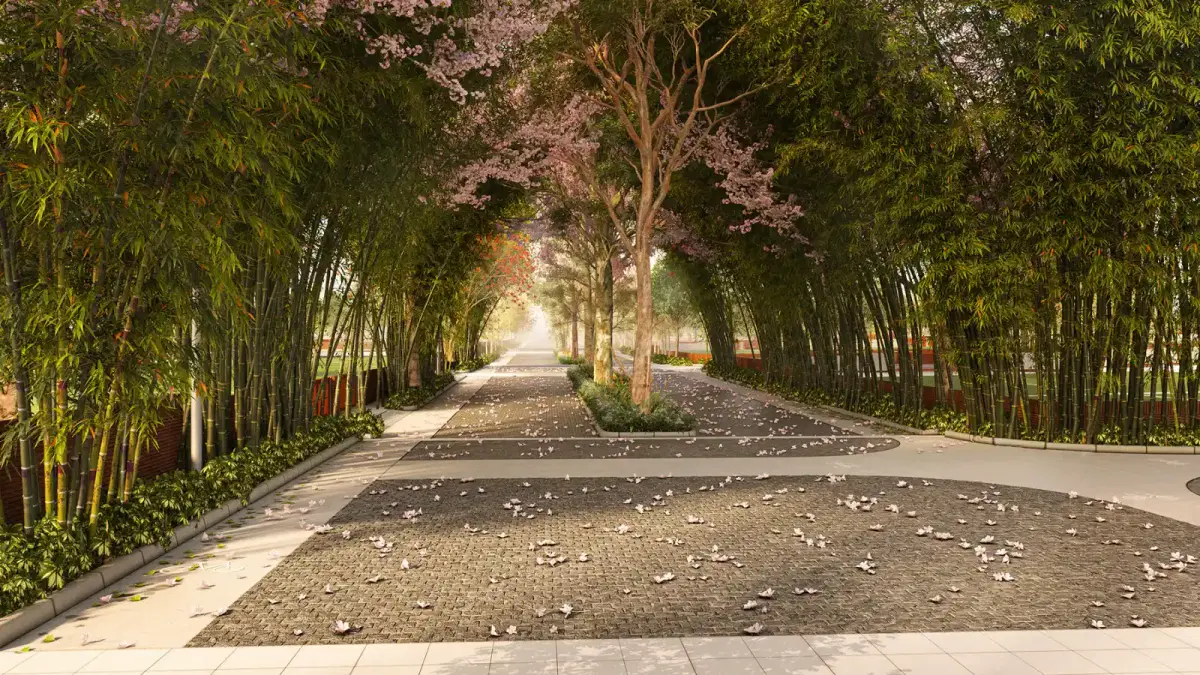
Investigating current high-end suburban real estate investment spaces clearly illustrates how modern property investors prioritize land asset preservation over vertical construction options. Across major infrastructure corridors in expanding northern metropolitan zones, validating developer credentials, regional employment drivers, and structural layout technology acts as the foundation for safe land acquisition. #link# highlights the precise operational parameters required to achieve true luxury community status. To gain an accurate understanding of these architectural environments, astute investors look past superficial cosmetic finishes to review foundational engineering benchmarks, spatial efficiency metrics, and land titles.
The Macro Economic Forces Reshaping Regional Land Valuation
The strategic deployment of international aviation gateways and peripheral ring roads transforms agricultural or secondary land parcels into high-value residential zones. Empirical data from global real estate markets confirms that industrial employment corridors creates an immediate demand pipeline for luxury custom build options featuring superior configurations. For example, when a premium property development sits within a brief 10 to 15-minute drive from a major international airport terminal, the long-term capital appreciation trajectory becomes remarkably insulated from temporary localized supply spikes. Additionally, the consistent generation of high-paying tech jobs, aerospace engineering roles, and startup enterprise positions guarantees that housing demand remains highly resilient across all luxury configuration categories. To truly map these appreciation models, staying updated on real estate pricing matrices remains essential.
Infrastructure Material Specifications and Low-Density Spatial Philosophy
The premium valuation of a premier residential estate over multi-decade cycles rests completely on the selection of premium infrastructure design and precision layout planning. Implementing wide internal road networks with standardized civil engineering precision dramatically accelerates structural layout timelines while ensuring uniform aesthetic value distribution across all sectors. When an elite real estate development prioritizes high-end architectural choices, the communal spaces frequently feature expansive internal roads, custom villa design flexibility, and expansive cross-ventilated biophilic alignments. Simultaneously, the overarching master plan philosophy is shifting decisively toward ultra-low-density configurations. By dedicating over 60 to 80 percent of the total available acreage to landscaped gardens and natural forest reserves, the project successfully insulates its inhabitants from urban chaos, air pollution, and noise disturbances. These detailed structural parameters clearly separate authentic luxury real estate from standard mass-market developments.
Decoding Pre-Launch Capital Entry Tactics and Land Valuation Models
When assessing historical asset performance across competitive financial markets, capturing early-stage pre-launch inventory from a reputed multi-state developer minimizes capital entry risk. Entering a tier-1 development phase before the public distribution of marketing brochures optimizes the overall return on investment by reducing immediate cash-flow outlays during early engineering stages. In parallel with capital gains, steady compounding trajectories check here from luxury airport corridors provides long-term stability due to continuous physical development and high owner retention rates. The golden rule of modern property acquisition dictates that financial commitments must align with strict legal checks. Verifying complete state-specific real estate regulatory authority compliance, widely known as the RERA approval registration, protects the individual home buyer by binding the developer to legally enforceable completion timelines and specifications.
Integrating Custom Architecture Frameworks with Sustainable Living
The modern luxury land consumer no longer views a plot as just a collection of private square footage. Deploying cutting-edge sustainable infrastructure along with predictive eco-friendly management systems, allows residents to effortlessly manage spatial layout choices, custom villa integration pipelines, and visitor tracking protocols. This physical design transition is heavily backed by the development of massive multi-level lifestyle clubhouses. Providing comprehensive personal wellness facilities, dedicated therapeutic meditation lawns, and nature trails, these spaces cater perfectly to multi-generational requirements while fostering authentic neighborhood connections. In addition to this, implementing zero-waste rainwater harvesting models and sustainable solar energy networks guarantees that the entire township remains completely sustainable and eco-friendly for decades to come.
Summary of Indispensable Benchmarks for Premium Land Portfolios
Ultimately, the selection of an elite land asset must extend far past superficial visual marketing: undivided land share protections, long-term asset compounding capacity, and localized employment trends. Capital allocators who aggressively target early-stage entry pricing within low-density integrated townships will successfully future-proof their capital holdings against urban congestion and economic adjustments. As high-growth metropolitan corridors continue to transition into fully self-sustaining smart-city nodes, property holdings situated within well-connected residential hubs are guaranteed to dominate the regional real estate market.